Rotted Fascia Boards: Signs, Causes and What Repair Costs in Morris County
How do you know a fascia board is rotted?
A fascia board is rotted when a screwdriver tip sinks into the wood, when the paint peels and the surface feels spongy, or when the board no longer holds the gutter straight. This Old House lists cracks, splits, holes, peeling paint, mold, moss and wet spots as the visible signs, with the screwdriver test as the quick check.
Fascia is the board that runs along the bottom edge of the roof, at the ends of the rafters. Gutters hang from it, and the lowest row of shingles overhangs it. Because it sits where roof water arrives and where gutters can overflow, it is one of the first exterior wood parts to fail. Catching it early often keeps a repair small.
What does rotted fascia look like from the ground?
You can spot most problems from the yard with a pair of binoculars, or from a ladder placed safely by someone who knows how. Look for these:
- Paint that blisters or flakes in one run of the roof edge, while the rest of the house looks fine.
- Dark staining or green growth along the lower edge of the board, especially below a gutter seam or a downspout outlet.
- Gutter sections that sag or pull away because the screws or spikes no longer hold in soft wood.
- Gaps or soft spots at corners and seams, where two boards meet and water finds the joint.
- Water stains on the soffit, the underside of the roof overhang, which suggest water is getting past the fascia.
- Chewed or enlarged holes, which may mean pests used softened wood as a way in. Our post on squirrels getting into the soffit and roofline explains why rotted trim invites animals.
Do the screwdriver test only where you can reach safely from the ground or a stable ladder. If the tip sinks in easily, the board is soft all the way through, not just on the paint.
What causes fascia boards to rot?
Water causes it, and gutters are usually how the water gets there. This Old House ties fascia rot to moisture, to clogged gutters and a damaged drip edge, to flashing that does not keep water off the wood, and to wood that is unpainted or unsealed. Wood is more vulnerable to rot than synthetic fascia materials.
In practice the pattern looks like this:
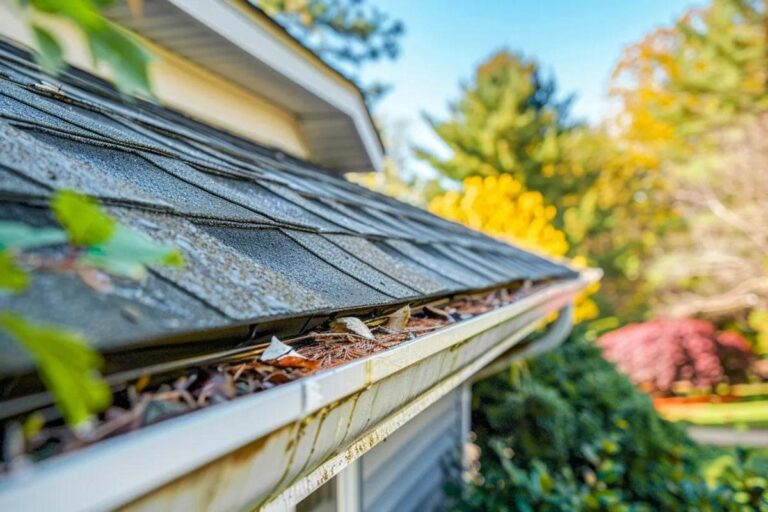
- A gutter clogs with leaves and shingle grit, so water backs up and spills over the edge.
- The spill runs down the face of the fascia and soaks its top edge, where the paint is thinnest.
- In winter, the water that wicked into the board freezes and expands, widening cracks.
- Once the paint film breaks, the wood stays damp longer and rot sets in.
Ice dams add a second route. Building Science Corporation explains that ice dams form when the upper roof runs warmer than the lower roof, so meltwater refreezes at the eaves and can back up under the shingles toward the fascia. If your fascia rots on the same sections each year, ask whether the cause is a gutter fault or a roof-edge detail, because fixing only the board brings the problem back. A roof repair may be part of the answer when the roof edge is letting water in.
Can rotted fascia be repaired, or does it need replacing?
Small areas of damage can be repaired, and localized damage may mean replacing only part of the board. If the board is soft along a long run, or the rot has reached the rafter ends or the soffit, replacement is the sound choice. This Old House says that if damage is localized, such as from a storm, you may only need to replace part of the fascia.
| What you find | Likely scope | Why |
|---|---|---|
| Paint flaking, wood firm under a screwdriver | Scrape, prime, repaint, fix the water source | The board is intact; the finish failed |
| One soft spot near a seam or corner | Cut out and replace a short section | Rot is local |
| Soft along a full run | Replace the full board | Rot has spread and fasteners will not hold |
| Soft board plus stained soffit or rafter ends | Replace fascia and check the framing behind it | Water has traveled behind the board |
| Board sound but gutter sags | Re-hang gutter with proper fasteners | The problem is the hanger, not the wood |
A repair that leaves wet or decayed wood behind a new board will fail. The decision to patch or replace is best made when the old board is off and the wood behind it can be seen. A good estimate says this up front: the price is for the visible scope, and hidden damage is handled as a separate item once it is exposed.
What does fascia board repair cost?
Published cost guides give a wide range, and the figures below are not a Hidalgo quote. According to HomeAdvisor’s 2025 cost guide, water damage repair to fascia and soffit runs $10 to $23 per linear foot, and dry rot repair runs $500 to $4,000 overall. HomeAdvisor reports an average cost for fascia and soffit work near $2,500, with typical totals of $1,050 to $3,300.
This Old House, in a fascia replacement cost guide updated in March 2026 and drawing on HomeAdvisor and Angi data, gives $7 to $40 per linear foot for replacement including labor and materials. Its per-foot material figures are $1 to $3 for wood, $1 to $5 for fiber cement, $1 to $8 for composite, $3 to $7 for PVC, $5 to $9 for vinyl and $8 to $20 for aluminum, with labor at $6 to $20 per linear foot. The guide pegs a typical single-story home at about 250 linear feet of fascia.
Those ranges are national averages from consumer cost sites. They do not account for a two-story roof edge, a complex roofline with dormers, or hidden damage found after removal. Several things move the number:
- Height and access. Two-story eaves cost more to reach safely than a single-story edge.
- Length. One failed 12 foot section is a different job from a full perimeter.
- Material. Wood is cheapest up front. Aluminum and PVC cost more but resist rot.
- Hidden damage. Rotted rafter ends or soffit panels are added work once the board is off.
- Gutters. Gutters usually come down for the work, and reinstalling or replacing them is part of the scope.
For a number that applies to your house, get a written estimate. We give free, written estimates and separate the board from any larger finding.
What material should replace a rotted fascia board?
Replace wood with wood only if you are prepared to keep it sealed and painted. This Old House lists wood, fiber cement, composite, PVC, vinyl and aluminum as options, and notes that wood is the most susceptible to rot and water damage. A wrapped or cellular PVC board takes more of the maintenance burden off the homeowner.
When you choose, think about three things: how much upkeep you want to do, how the new board will match the trim and the soffit, and what the neighbors’ roof edges look like. Ask each contractor to name the product, the thickness and how the board will be sealed on the cut ends. Cut ends and fastener holes are where moisture re-enters.
What happens during a fascia repair visit?
The visit starts with a look at the roof edge and gutters, and ends with a written estimate that names the work. On repair day, the gutters come off or are supported, damaged material is removed, and the framing behind it is checked. New board is fastened, the seams are sealed and primed, and gutters go back up.
This Old House notes two installation details: boards should be at least 2 inches wider than the rafter ends, and every seam should be caulked for a watertight joint. Afterward, gutters, downspouts and drip edges are reinstalled. We clean up the job site and walk you through the finished work. If something does not look right later, we want to hear from you.
Rot rarely shows up alone. If you are in Denville or anywhere in Morris County, a roof edge repair is a good time to review gutter pitch and downspout drainage, too. Our gutter installation and repair page covers the options, and our guide on where downspouts should drain explains how to keep the water off the board in the first place.
Frequently asked questions
How can I tell if my fascia is rotted or just needs paint?
Press a screwdriver tip into the board. If it sinks in or the wood crumbles, the wood is rotted. If the wood is firm and only the paint is peeling, scraping, priming and repainting may be enough, provided you also fix whatever is wetting the board.
Can rotted fascia wait until spring?
A small soft spot can often wait a few weeks, but it should not wait for years. Soft fascia can let gutters pull away and let water reach the rafter ends and soffit, which makes the repair larger. Schedule an inspection before winter if you see soft spots or sagging gutters.
Can I just replace one section of rotted fascia?
Often, yes. If the rot is limited to a short section and the wood on either side is sound, a section can be cut out and replaced. If the board is soft along a long run or the rot has reached the framing, replacing the full board is the better call.
How much does it cost to replace fascia boards?
According to This Old House’s March 2026 cost guide, replacement runs $7 to $40 per linear foot including labor and materials. HomeAdvisor’s 2025 guide puts water damage repair at $10 to $23 per linear foot. These are national averages, not a Hidalgo quote; a written estimate shows your actual number.
Why does my fascia keep rotting in the same place?
A repeat location points to a repeat water source, such as a gutter seam that leaks, a downspout that overflows, a missing drip edge or an ice dam at that spot. Replacing the board without fixing the source simply starts the clock again.
Sources and further reading
- This Old House: Fascia Board Replacement Cost (accessed 2026-10)
- This Old House: How to Repair a Fascia Board (accessed 2026-10)
- HomeAdvisor: Cost to Replace or Repair Fascia Boards and Soffits (accessed 2026-10)
- Building Science Corporation: BSD-135 Ice Dams (accessed 2026-10)