
Home / Areas We Serve / Bergen County / Ridgewood
Roofing · Ridgewood, Bergen County
Roofing Contractor in Ridgewood, NJ
Ridgewood’s oldest streets grew up between 1900 and 1930. We repair and replace the roofs, gutters and siding on its colonials, Tudors and later capes.
★ 4.5 on Houzz · find and review us on
✓ Free written estimate
✓ NJ HIC #13VH08024500
✓ Family-owned since 2014
Free estimate in Ridgewood
Free in-person estimate · No obligation · We reply fast

Family-owned since 2014
Wharton, NJ crew

NJ HIC #13VH08024500
State registered

Free written estimates
No pressure

7 NJ counties served
224 municipalities
How old are Ridgewood houses, and what does that mean for the roof?
Ridgewood is one of Bergen County’s oldest residential villages. Census estimates show about 38 percent of its 9,191 housing units were built before 1940 and half before 1950, so many roofs sit on century-old framing that has been re-covered several times and may still carry original slate or wood.
The village grew fastest in the first three decades of the twentieth century. Its population went from 2,685 in 1900 to 12,188 in 1930, according to decennial census counts listed on Ridgewood’s Wikipedia entry, more than quadrupling in a generation. Growth slowed after that, and relatively little was added after 1970.
| Year the house was built | Share of Ridgewood units | Typical roof conversation |
|---|---|---|
| 1939 or earlier | About 38% | Complex rooflines, board decking, possible slate or wood under later layers |
| 1940 to 1949 | About 13% | Usually several reroofs already; chimney and dormer flashing |
| 1950 to 1959 | About 24% | Capes and mid-century plans, now on their second or third roof |
| 1960 to 1979 | About 15% | Larger suburban plans; gutters and soffit ventilation |
| 1980 or later | About 11% | Newer roofs; flashing and penetrations rather than the shingle field |
Source: U.S. Census Bureau, ACS 2020-2024 5-year, table DP04, Ridgewood village. Shares are grouped from the published percentages. The same survey shows about 79 percent of units are one-family detached houses and about 83 percent of occupied homes are owner-occupied.
Which house styles shaped Ridgewood's rooflines?
Mostly the revival styles of the early 1900s, which means steep pitches, many intersecting planes and a lot of flashing. The Ridgewood Public Library’s local history pages describe each older neighborhood, and the roof work follows the architecture.
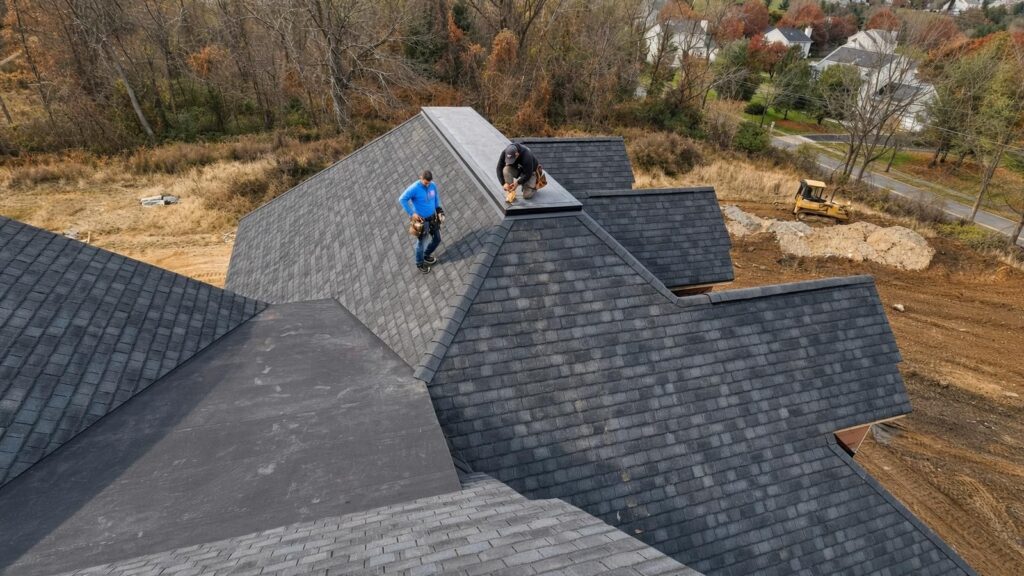
A Tudor Revival roof is the hardest of these to keep dry. Steep front gables, cross gables, eyebrow or shed dormers and tall masonry chimneys create valleys and wall joints everywhere. Each valley concentrates water, and each place a roof meets a wall or a chimney depends on step flashing and counterflashing. When we prepare a roof repair estimate on one of these houses, most of the time goes into those joints rather than the open field of shingles.
Colonials are simpler above, but the details are older: a wide cornice, a front porch roof, and often a rear addition from a later decade with its own pitch.
What if a Ridgewood roof is slate or cedar?
Then treat it as a historic material before treating it as a problem. The National Park Service’s Preservation Brief 4, Roofing for Historic Buildings, notes that slate continued in use well into the twentieth century, notably on many Tudor Revival buildings of the 1920s, and that Colonial Revival styles kept wood shingles among the most fashionable roofing materials.
The same brief recommends recording the existing roof before any work, including slate sizes, colors and patterns, and photographing details at gutters, flashing, dormers, chimneys, valleys, ridges and eaves. It also warns that substitute materials can change a building’s character.
Slate and wood roof restoration are specialist trades, and we say so up front: ask us whether we can quote your particular roof. What we routinely handle on these houses is the work around them. That includes cedar shake siding on walls and gables, gutter and fascia work below the roof edge, and a full roof replacement where an owner has already chosen asphalt shingles for a roof that was re-covered long ago.
Heads up: Some houses hide an old wood or slate roof beneath later asphalt layers. Tearing off reveals what is really there, so the estimate should say how surprises in the deck will be handled.
Talk to Hidalgo Brothers about your Ridgewood roof
Does Ridgewood's Historic Preservation Commission review exterior work?
It can, depending on where the house is. Ridgewood has a Historic Preservation Commission that the village says surveys and inventories buildings of historical or architectural significance and advises the Planning Board and Zoning Board of Adjustment on development applications.
The commission’s page links to a list of Ridgewood historic districts, design guidelines for the Village Center Historic District and a historic preservation permit application. Separately, a dozen Ridgewood properties appear on the National Register of Historic Places, among them the Paramus Reformed Church Historic District, listed in 1975, and Ridgewood Station at Garber Square, listed in 1984.
Before choosing a new roofing or siding material on an older house, two calls settle the question:
| Situation | Who to ask, and what |
|---|---|
| Any re-roof or siding job | Building Department: is a construction permit needed? |
| House in a designated district or listed as a landmark | Historic Preservation Commission: is a historic preservation permit needed? |
| Changing material or color on a visible elevation | Both offices: does the change need review before work starts? |
| New deck, addition or dormer | Building Department and the zoning office: which approvals apply? |
The Building Department enforces the New Jersey Uniform Construction Code and local zoning from Village Hall at 131 N Maple Avenue, and can be reached at 201-670-5500, extension 2281. Permits and approvals come from the village, and the homeowner can confirm the requirements directly there. Our written estimate names every material so either office can see exactly what is proposed.
★★★★★
“The workmanship was top notch, the crew was pleasant and helpful.”
Frank Bell · Google review · Jul 2020
How do Ridgewood's street trees affect gutters?
They fill them, twice a year and after every heavy storm. The village’s Shade Tree Commission says Ridgewood has more than 10,000 street trees, and older lots add mature trees of their own, which is why gutter work is a big share of what older houses need here.
Preservation Brief 4 makes the point directly: gutters accumulate leaves and debris in spring and fall and after heavy rain, and clogged gutters let water back up and seep under roofing, eventually rotting fasteners, sheathing and framing. It suggests screening at downspouts and along the gutter as one way to keep them clear.
Practical checks for a tree-heavy Ridgewood lot:
Our seamless gutter installation and repair page explains sizing and downspout placement.
Where does water go when the Saddle River or Ho-Ho-Kus Brook rises?
Into the lowest houses first, which makes downspout discharge matter. Ridgewood formed a Residential Flood Advisory Committee in January 2025, and its resident seats are split among people flooded by the Saddle River, by the Ho-Ho-Kus Brook and by stormwater runoff.
A roof cannot hold back a river, but it decides how much rainwater lands beside your foundation. On a low lot we check that every downspout discharges well away from the house, onto ground that slopes outward, and that the gutters are not overflowing at the corners. Our guide to where downspouts should drain compares extensions, splash blocks and underground lines.
Winter adds a second water problem. New Jersey’s Division of Codes and Standards says the code ice-barrier requirement applies only where the January average daily temperature is 25 degrees Fahrenheit or lower, which it identifies as Sussex County. Ridgewood is outside that area, yet older houses with warm attics and shallow eaves still get ice dams. Asking what goes along the eaves is still a fair question on any Ridgewood estimate.
Have a roofing question in Ridgewood?
Monday to Friday, 8:00am to 6:00pm. Estimates are free and in writing.
Which neighbouring towns do we also serve?
Ridgewood is in Bergen County and borders Fair Lawn, Glen Rock, Ho-Ho-Kus, Midland Park, Wyckoff, Paramus, Waldwick and Washington Township, plus Hawthorne in Passaic County, according to Wikipedia. Two nearby places have their own pages:
Our shop is at 350 W Dewey Ave in Wharton, in Morris County, and we serve all of New Jersey from there. We are family-owned since 2014 and do not claim a history in Ridgewood we do not have. What we offer is a careful inspection and a free written estimate; you can ask for one here.
Frequently asked questions
How old are most houses in Ridgewood, NJ?
Census estimates for 2020 to 2024 show about 38 percent of Ridgewood housing was built before 1940 and about half before 1950. Another quarter dates from the 1950s. Only about 11 percent was built after 1980, so most roofs sit on older framing that has been re-covered more than once.
Why do Tudor-style houses in Ridgewood leak so often?
Their rooflines have many valleys, cross gables, dormers and tall chimneys. Each valley concentrates water, and every roof-to-wall or roof-to-chimney joint depends on flashing that ages faster than the shingles. Most leaks on these houses trace back to one of those joints.
Can you repair a slate roof in Ridgewood?
Slate restoration is specialist work, so ask us whether we can quote your particular roof before assuming. We can inspect the gutters, flashing and roof edge, and replace an asphalt roof that already covers the house. For a true slate roof, a written assessment of what to keep is the right first step.
Do I need Historic Preservation Commission approval for a new roof?
That depends on whether your house is in a designated historic district or listed as a landmark. Ask the Building Department and the Historic Preservation Commission at Village Hall before choosing materials, and keep their answer in writing. Houses outside any district typically deal only with the construction office.
How often should gutters be cleaned on a Ridgewood house with big trees?
At least in spring and fall, and again after any heavy storm that brings down leaves or seed pods. The National Park Service lists those as the times gutters fill. Houses under tall oaks or maples may need more frequent checks, or guards matched to the tree type.
Is an ice barrier required on a Ridgewood roof?
Not by the state code. New Jersey requires an ice barrier only where January average temperatures are 25 degrees Fahrenheit or lower, which the state says is Sussex County. Ridgewood homeowners with a history of ice at the eaves can still ask for eave protection on a new roof.
Do you replace cedar shake siding on older Ridgewood homes?
Yes. Cedar shake siding is one of our siding services, along with fiber cement, vinyl, PVC cedar-look and composite options. On older houses we check the sheathing and trim behind the shakes and match exposure and coursing to the rest of the wall.
How do I book an estimate in Ridgewood?
Call (973) 525-6835, Monday to Friday, 8:00am to 6:00pm, or use the quote form. We visit, inspect the roof, gutters or siding, and send a written estimate that lists scope and materials. You can take your time and compare it with other bids.
Sources and further reading
Last reviewed: November 26, 2026 · Hidalgo Brothers Roofing, Wharton, NJ
Ridgewood on the map
On the job with Hidalgo Brothers
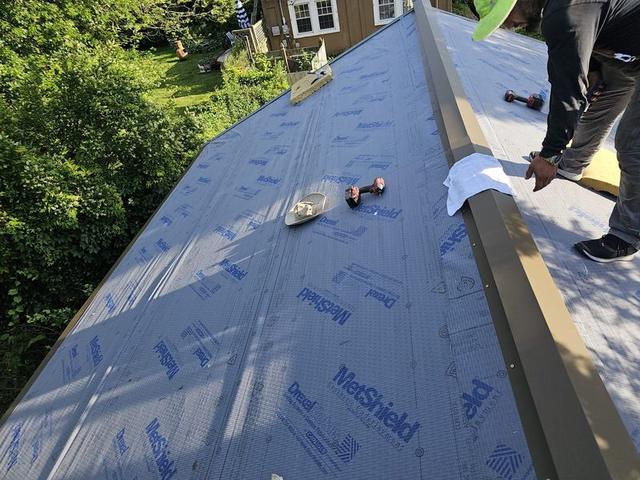
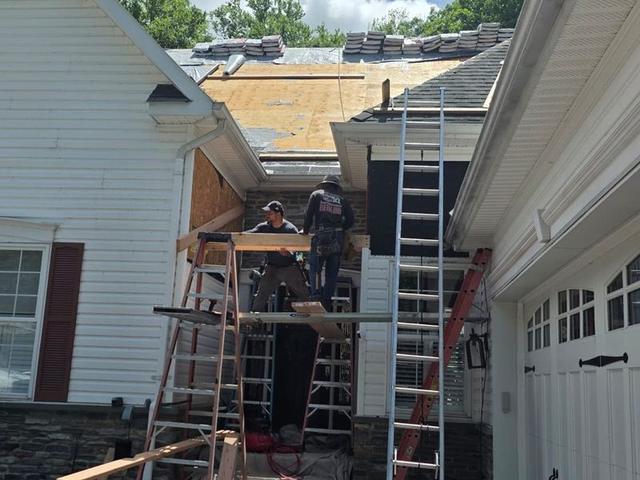
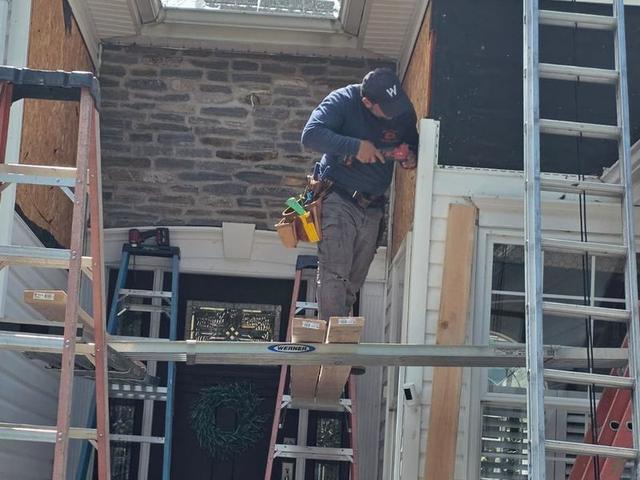
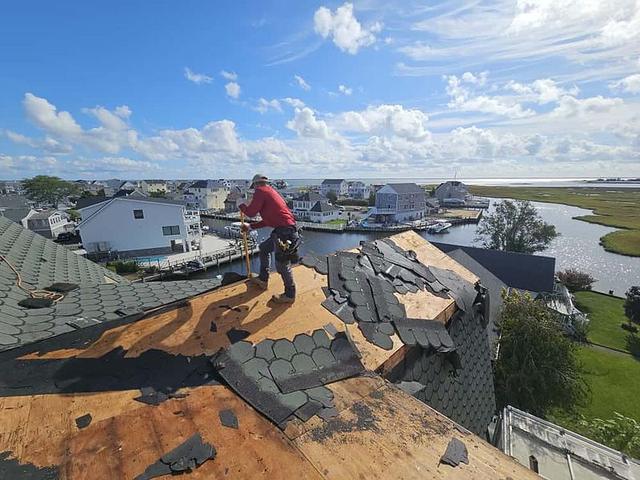
Photos from Hidalgo Brothers crews at work on New Jersey homes.
What homeowners say
4.5
★★★★★
Rated on Houzz
★★★★★
“Very happy with them! Did a great job with the roof! Cleaned up completely around the house after installing it. They are very reliable and stand by their work. A big branch fell on our roof and punctured some shingles. They came the next day and fixed it. Highly recommend!”
A
Anja Loe
Google review · Nov 2020
★★★★★
“I contacted them and they responded quickly and courteously. I had several issues that I wanted to discuss. They listened and I had an estimate within a very reasonable time. The workmanship was top notch, the crew was pleasant and helpful. The price was VERY reasonable. I would DEFINITELY recommend the Hidalgo Brothers for your home project!”
F
Frank Bell
Google review · Jul 2020
★★★★★
“Hidalgo Brothers reroofed my barn and my house. Both jobs were performed with 5-star professionalism, job performance, and clean up. I recommend Hidalgo Brothers for all your roofing needs. I look forward to working with them on future home improvement projects.”
J
Jay Engels
Google review · Apr 2019
Read more reviews on
From free estimate to final walkthrough
01
Free estimate
We inspect your roof, siding, gutters or deck and give you a written estimate.
02
Planning
We confirm details, help with material selections and schedule around your household.
03
Installation
Work is completed to code and manufacturer specs, with updates throughout.
04
Cleanup & walkthrough
We clean the jobsite and walk through the finished work with you.
05
Ongoing support
If something doesn’t look right after the project, we want to hear from you.
All 21 New Jersey counties.
Hidalgo Brothers works across New Jersey from our base in Wharton, Morris County. Choose your county to see the towns we cover.