Why Prompt Siding Repair Matters for a New Jersey Home
Why does a small siding flaw turn into a big repair?
Because water follows the flaw into the wall. A cracked panel, a gap at trim or a loose course lets rain reach sheathing and framing, where it stays wet for weeks. Wood in the wall rots, insulation sags, and the repair grows from one panel to a section of wall. Catching the flaw early keeps the job small.
Siding is a weather layer, not a sealed shell. It is meant to shed most water and let the barrier and flashing behind it deal with the rest. When the outer layer breaks, the system behind it works harder than it was designed to, and it eventually loses. That is the case for repairing promptly, and it holds whether your siding is vinyl, fiber cement, wood or composite.
If you are weighing repair against a full re-side, our fiber cement vs vinyl installation comparison explains how materials differ once on the wall.
What are the warning signs that siding needs attention?
Look for change, not perfection. Walk the house once or twice a year with a notepad, and compare what you see to last time.
- Cracks, holes or chips that open a path to the wall.
- Panels that are loose, buckled or rattling in wind.
- Gaps at corners, trim or around lights and vents.
- Soft, spongy or stained boards, especially near the ground and under roof edges.
- Peeling or bubbling paint on wood or fiber cement.
- Interior clues such as musty smells, stains on walls or a window that fogs for no reason.
Press the lowest boards with a screwdriver tip. If the tool sinks in easily, the wood is damaged. Mark what you find with painter’s tape so a contractor can see it.
What usually causes siding damage in New Jersey?
Impact, wind, sun, moisture and age account for most of it. Storm debris and tree limbs crack panels. Wind lifts loose courses. Sun fades and embrittles some materials over the years. Water from overflowing gutters, roof edges and splash-back soaks the lowest courses and the wall behind them.
Third-party testing shows what vinyl is supposed to withstand when it is new. PEPA says certified vinyl siding complies with ASTM D3679 and is tested for weatherability, wind load, impact resistance, expansion and shrinkage, surface distortion, thickness and rate of burn (PEPA: certified vinyl siding). Those are lab results on new panels. After 15 or 20 years outdoors, each of those properties can look different, and installation errors may have added stress.
Gutters deserve a look, because overflow wets siding from above and below. Our article on where downspouts should drain covers extensions and underground drains.
Which repairs can a careful homeowner handle?
Small, cosmetic jobs are fine for confident DIYers, and anything involving water behind the wall or a ladder above one story is not. Match the job to your skills and equipment.
| Problem | DIY-friendly? | Notes |
|---|---|---|
| Dirt, algae or light mildew on vinyl | Yes | Gentle cleaning with a soft brush and hose |
| Loose vinyl panel with intact nail hem | Sometimes | Must slide and relock, not be nailed tight |
| Small hole in a single panel | Sometimes | Replacement panel is better than filler for vinyl |
| Peeling paint on one small area of wood | Yes, with care | Pre-1978 paint may contain lead; see below |
| Rot, soft sheathing or wet insulation | No | Needs opening the wall and fixing the cause |
| Work from a high ladder or roof edge | No | Fall risk and flashing details |
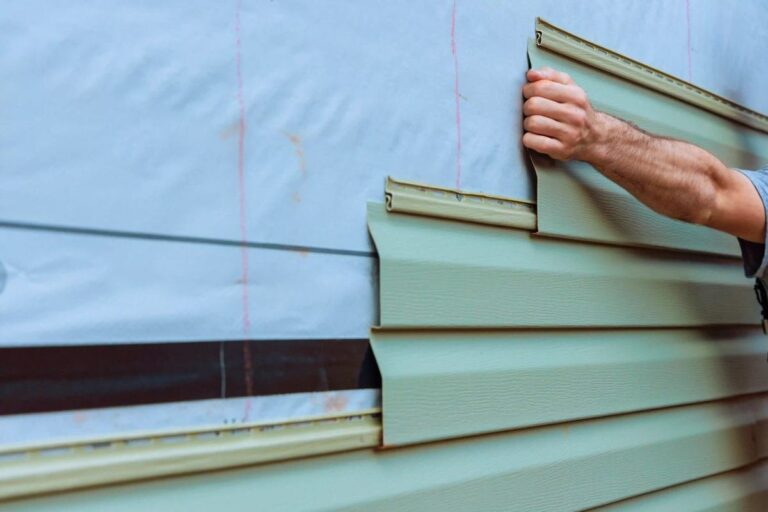
If you replace a vinyl panel yourself, follow the loose-fit rule. PEPA says to leave about 1/32 inch between the nail head and the panel, to center nails in their slots, and to keep at least 1/4 inch clearance at openings (PEPA installation tips). Tight nails cause the next failure.
What should always be handed to a professional?
Anything that suggests the wall itself is wet or damaged, anything on a tall or steep elevation, and anything involving painted surfaces on a pre-1978 house. Rot found behind siding has to be cut out and replaced, and the source of moisture has to be found. Otherwise the new siding hides a continuing problem.
Lead is a real consideration. The U.S. EPA says anyone paid to disturb paint in housing built before 1978 must be certified in lead-safe work practices, and workers must be trained (EPA: Renovation, Repair and Painting program). Do not dry-scrape or sand old paint on an older house without lead-safe precautions.
Also remember that trim rot ties into other parts of the roofline. If you see damaged fascia or soffit next to the problem siding, see our guide to rotted fascia boards.
What do you get from repairing early?
The benefits are practical. A prompt repair stops moisture, keeps the wall dry, avoids secondary damage and prevents a small cost from becoming a large one. It also keeps the house presentable and keeps maintenance records tidy for the day you sell.
Fiber cement and wood add a paint component. The Forest Products Laboratory says wood is easier to repaint before the first coat fails, ideally when the topcoat has weathered to the point that the primer is just starting to show (USDA Forest Products Laboratory: Paint, Stain, Varnish, or Preservative?). Its guidance on life span lists paint at 7 or more years, solid-color stains at 3 to 7 years and semitransparent stains at 3 to 8 years. Waiting until paint has peeled adds scraping, priming and extra coats.
James Hardie describes its fiber cement lap siding as noncombustible under ASTM E136, with a note that paints and coatings are not covered by that rating, and lists a 30-year substrate warranty that is non-prorated, limited and transferable (James Hardie: HardiePlank lap siding). A maker’s warranty typically has conditions, so keep your installation records and read the terms.
How does a seasonal routine catch problems early?
A short routine twice a year is enough. Do it in spring and in fall, ideally after a heavy storm too.
- Walk each elevation and look for new cracks, loose panels and gaps at trim.
- Check the lowest course for soft spots and staining.
- Make sure gutters are flowing and downspouts discharge away from the wall.
- Trim shrubs and branches that rub or hold moisture against the siding.
- Photograph each wall so you can compare next time.
- Write down anything suspicious and have it looked at before winter.
Fall is a good moment to finish repairs. Freeze and thaw can open small gaps, and frozen sheathing is harder to fix. Pair this with a look at downspouts and eaves, since gutters and siding share the same water.
How do you hire a repair contractor with confidence?
Use the state’s rules as your checklist. The New Jersey Division of Consumer Affairs says home improvement contracts above $500 must be written, include a description of the work, start and completion dates, the total price and the registration number, and may be cancelled for any reason before midnight of the third business day (NJ Division of Consumer Affairs). It also says not to make the final payment until the work is completed.
On permits, the published text of N.J.A.C. 5:23-2.7 lists repairing or replacing existing siding on one- and two-family dwellings as ordinary maintenance that needs no permit application (Cornell LII). Check with your town for anything beyond like-for-like work.
Hidalgo Brothers serves all 21 New Jersey counties, with Morris County as home. If you are unsure whether your siding needs a patch or more, see the siding repair and installation overview or ask for a free estimate.
Frequently asked questions
Can I just caulk a crack in vinyl siding?
Caulk is a temporary cosmetic fix at best. Vinyl moves with temperature, so rigid filler tends to crack and let water in again. A cracked panel is normally replaced with a matching piece. If you cannot find a match, an installer may be able to borrow a panel from a hidden area.
How long can I wait before repairing damaged siding?
Do not wait through a wet season. Exposed gaps let water reach sheathing, and wood that stays wet is the kind that decays. If the damage is minor and the wall behind it is dry, a short delay is manageable. Place a temporary cover and book the fix.
Does siding repair affect resale value?
Condition affects how buyers and inspectors see a house. Visible damage invites questions about moisture. Records of timely repairs help. Exact effects depend on the market and the house, so avoid assuming a number. A written scope and photos of completed work are useful to hand over at sale.
Is it normal for vinyl siding to rattle in the wind?
Light movement is normal because panels are designed to slide. Loud rattling, panels lifting at the bottom edge or visible gaps are not. They suggest loose or missing fasteners, a failed lock at the lower edge or damage. A contractor can re-secure the panel or replace it.
Should I clean mold off my siding before calling someone?
A gentle wash with a soft brush and mild detergent is reasonable on vinyl. Avoid forcing water up behind laps with a hard spray. If growth returns quickly or the wall behind feels damp, treat that as a moisture signal and have the cause checked, not just the stain.
What kind of damage is covered by a manufacturer’s warranty?
Manufacturer warranties usually cover defects in the product under stated conditions, not storm damage, installation errors or normal wear. Terms differ by product and year. Read the document that came with your siding, keep your invoice, and ask the manufacturer or the installer what is covered.
Sources and further reading
- PEPA: Certified vinyl siding products (accessed 2026-11)
- PEPA: Vinyl siding installation tips and tricks (accessed 2026-11)
- U.S. EPA: Renovation, Repair and Painting program (accessed 2026-11)
- USDA Forest Products Laboratory: Paint, Stain, Varnish, or Preservative? (accessed 2026-11)
- James Hardie: HardiePlank lap siding (accessed 2026-11)
- NJ Division of Consumer Affairs: Hiring home improvement contractors (accessed 2026-11)
- Cornell LII: N.J.A.C. 5:23-2.7 Ordinary maintenance (accessed 2026-11)