Skip to content

When to Schedule Siding and Gutter Installation: Summer and Beyond
Is summer the right season for new siding and gutters?
Summer is a good season for siding and gutters because long daylight hours and dry stretches let crews work through each wall without covering open sheathing overnight. It is not the only workable season, though. Spring and fall also suit the work, and materials set their own temperature limits.
The honest answer is that timing matters less than the conditions on the day of installation. A crew that checks the forecast, protects open walls and follows the manufacturer’s temperature rules can install siding in most months. A rushed job in the wrong weather causes more trouble than a job that waits a week.
This guide covers what changes with temperature, what summer storms mean for open walls, and the questions worth asking when you schedule exterior work.
How does temperature change siding installation?
Temperature changes how much siding moves, and installers have to leave room for that movement. The Polymeric Exterior Products Association, formerly the Vinyl Siding Institute, notes in its installation tips that vinyl siding can shift about 1/2 inch or more over a 12-foot-6-inch panel as temperatures swing.
Its rules are specific. Leave at least 1/4 inch of clearance at openings and stops, and increase that to 3/8 inch when installing below 40 degrees Fahrenheit. The fastener head should sit about 1/32 inch off the nailing hem, and nails are centered in the slots so the panel can slide. In heat, panels start longer, so a tight install that looks neat in July can buckle in August.
Fiber cement, cedar, composite and PVC cedar-look products each have their own gap and fastening rules. Our crew follows the manufacturer’s instructions for the product in your estimate.
| Season | Advantage | Watch for |
|---|---|---|
| Spring | Mild temperatures, good daylight | Rain delays and frequent showers |
| Summer | Long dry days, easy handling of materials | Heat expansion, afternoon storms, hot walls |
| Fall | Cool, steady weather | Shorter days, leaves in new gutters |
| Winter | Fewer schedule conflicts | Cold-weather clearances, brittle material, frozen ground |
What do summer storms mean for open walls?
New Jersey summers produce heavy short rain, and an exposed wall during a downpour is the main risk of summer siding work. The National Oceanic and Atmospheric Administration’s State Climate Summary for New Jersey shows that days with 2 inches or more of rain average 2.2 per year, and that remnants of Hurricane Ida dropped as much as 10 inches in places on September 1 and 2, 2021.
Heavy rain is rare on any given day, but crews plan for it. The Rutgers Office of the State Climatologist publishes monthly statewide and county precipitation records going back to 1895 if you want to see how wet a given month has run. Good practice includes:
- Stripping only as much old siding as can be closed in that day.
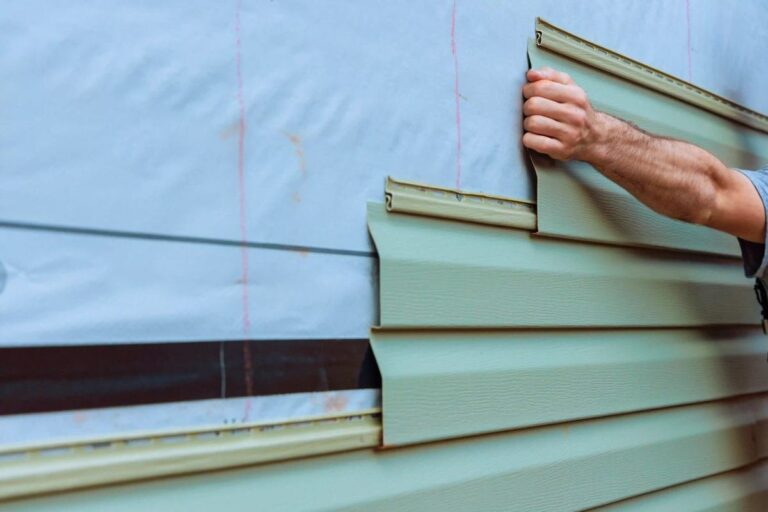
- Keeping the weather barrier lapped from the bottom up so water sheds outward.
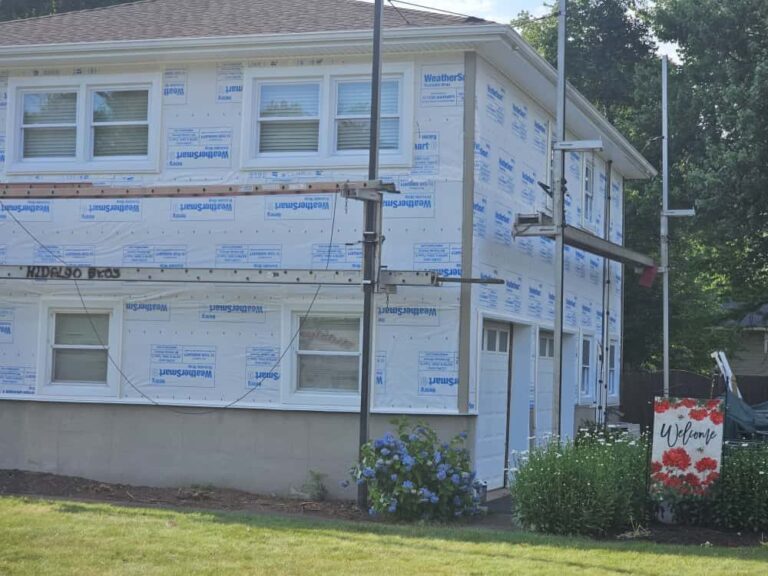
- Covering any exposed sheathing at the end of the day.
- Watching radar and pausing work when a storm cell approaches.
If you hire out the work, ask how the crew protects an open wall overnight and what happens to the schedule when a storm hits.
Does summer heat affect gutters?
Seamless aluminum gutters are formed on site and then hung, so summer heat has less effect on them than on siding. The more important step is matching pitch and outlets to the roof. This Old House notes that standard gutters pitch about 1/4 inch per 10 feet, and that runs of 60 feet or more should have at least two outlets. See the full gutter and downspout sizing guide.
A new gutter is only as good as the board it hangs from. If fascia is soft, it should be repaired first, a problem covered in our post on rotted fascia boards. Summer is also a good time to correct this, because wood dries out and paint cures well.
If you are comparing materials, our service pages explain vinyl siding and seamless gutter options in more detail.
Should roofing and exterior work be done together?
Doing related work in one season can save repeated setup and avoid undoing one trade’s work with another’s. The roof edge, gutters, fascia and top of the siding all meet in the same strip of the wall. If a roof replacement is on your horizon, finishing it before new siding and gutters prevents scuffs and fallen debris on a fresh finish.
Attic heat is also a summer topic. The Asphalt Roofing Manufacturers Association notes on its page about attic ventilation in cold and warm climates that summer attic heat can radiate into living spaces and strain air conditioners. If you plan a roof project, ask about ventilation at the same time you plan the exterior.
Hidalgo Brothers works on residential roofing, siding, gutters and decks, so one estimate can cover several items. Ask us about roof replacement if the roof is also near the end of its life.
What should you ask before you book summer work?
The questions below apply in any season, but they matter most when many homeowners call at once.
- Which product will go on the wall, and what are the manufacturer’s temperature and gap rules?
- How will you protect open walls and landscaping each day?
- Who removes old material and where does it go?
- What is the written scope, and are the roof edge and fascia included?
- What is the start window, and how do weather delays work?
- Who do I call after the project if something does not look right?
Under the Hidalgo Brothers process, you receive a free, written estimate, a planning step to confirm details, installation to code and manufacturer specifications, a cleanup and walkthrough, and ongoing support. Our NJ Home Improvement Contractor license number is NJ HIC #13VH08024500.
Common timing mistakes
- Waiting until a leak or sag forces the schedule instead of planning the work.
- Installing new gutters before a roof project that will disturb them.
- Expecting identical results from every season without checking the forecast.
- Choosing a contractor on start date alone, without comparing written scopes.
- Painting or sealing exterior wood when it is still damp from a storm.
If you want a quote for siding or gutters, start with the free estimate page and tell us what the house looks like now.
Frequently asked questions
Can siding be installed in winter?
Yes, with adjustments. Vinyl needs extra expansion clearance below 40 degrees Fahrenheit, and material is more brittle and can crack when cut or struck. Ground may be frozen or snow-covered, so site prep is harder. Many crews keep working through cold months, but ask how they handle each of these.
Does the weather barrier go on before siding?
Yes. A weather-resistant barrier is installed over the sheathing before the siding, with seams lapped so water runs outward and down. Flashing at windows, doors and roof meetings is part of that layer. Ask who is responsible for it, because it is hidden once the siding is on.
Can gutters be installed in the rain?
Light rain does not stop gutter work, but heavy rain does. Wet fascia is a poor base for fasteners and sealants, and ladders are less safe. A reputable crew will pause for storms and recheck the pitch with a water test once the weather clears.
How long does siding installation take?
It depends on the size of the house, the number of corners, windows and trim details, and the material. A small ranch may take only a few days, while a larger home with complex trim takes longer. Ask for a schedule range in the written estimate and for how weather changes it.
Should I paint or replace my siding?
Paint is a finish, not a repair. If the siding is cracked, warped or loose, or the wall behind it is wet, painting will not fix it. Siding in good shape with a faded finish may be a candidate for paint, depending on the material and manufacturer instructions.
What if the weather turns bad during installation?
The crew should close up any open wall and protect the exposed sheathing before leaving. Ask for this in the plan. After a storm, a quick check for water behind new trim or flashing is reasonable before the job resumes.
Sources and further reading
- Polymeric Exterior Products Association: Vinyl Siding Installation Tips and Tricks (accessed 2026-11)
- NOAA NCICS: State Climate Summary for New Jersey (accessed 2026-11)
- This Old House: How to Size Gutters and Downspouts (accessed 2026-11)
- ARMA: Attic Ventilation Important for Cold and Warm Climates (accessed 2026-11)
- Rutgers NJ Climate Office: State Climatologist (accessed 2026-11)