How Much Snow Can a Roof Hold? Snow Load Warning Signs for Morris County Homes
How much snow can a roof hold?
There is no safe number of inches, because a foot of snow can weigh anywhere from 3 to 21 pounds per square foot depending on how wet it is. A roof built to code carries a design load for your location, and most roofs have reserve capacity. The risk rises with wet snow, rain on snow and drifting.
Federal guidance is blunt about one point. FEMA’s Snow Load Safety Guide, publication P-957, says most buildings are not at risk of snow-induced failure. It also says that attempting to remove snow from a roof is more hazardous than beneficial more often than not. So the practical question is rarely “how many inches” and more often “what does this snow weigh and does my house show any distress.”
How much does snow actually weigh?
FEMA’s guide gives the working numbers. It states that one foot of fresh snow ranges from 3 pounds per square foot for light, dry snow up to 21 pounds per square foot for wet, heavy snow. It also says one inch of ice weighs a little less than 5 pounds per square foot, and a foot of ice weighs about 57. Ice, in other words, is far heavier than even the wettest snow.
| What is on the roof | Approximate weight | Basis |
|---|---|---|
| 1 foot of light, dry snow | About 3 pounds per square foot | FEMA P-957, per-foot figure |
| 1 foot of wet, heavy snow | About 21 pounds per square foot | FEMA P-957, per-foot figure |
| 2 feet of wet, heavy snow | About 42 pounds per square foot | Calculated from FEMA’s per-foot figure |
| 1 inch of ice | A little under 5 pounds per square foot | FEMA P-957 |
| 1 foot of ice | About 57 pounds per square foot | FEMA P-957 |
Two things change those numbers in a real storm. Snow settles and compacts under its own weight, so older snow is denser than the fresh powder that fell on top of it. Rain also matters. FEMA explains that a short period of rain can make snow melt and become further saturated, which significantly increases the load, while continuous rain can wash snow away. Building codes include light rain on snow but not heavy rainfall, so that extra weight is a separate engineering question.
What is the snow load design value for Morris County, NJ?
New Jersey does not give a single county number to look up. The Department of Community Affairs (DCA) Bulletin 19-1, issued in September 2019 and revised in September 2022, tells designers to get ground snow load from the Applied Technology Council hazard tool or the ASCE hazard tool, using the building’s street address or latitude and longitude. It warns that searching only by city or zip code returns the centroid of that area and could understate the value for your site.
The bulletin ties the ground snow value to Section 1608 and Figure 1608.2 of the building subcode, or to Section R301.2.3 and Figure R301.2(6) of the one- and two-family dwelling subcode. Only when the tool returns “case study (CS)” may a designer fall back on older Bulletin 94-8 values. For Morris County that fallback is 35 pounds per square foot, compared with 50 for Sussex, 35 for Warren and Hunterdon, 40 for Passaic and 30 for Somerset.
Keep two cautions in mind. First, ground snow load is a map value that engineers convert to a roof design load using the roof’s shape, exposure and other factors, so it is not the same as what your roof can hold. Second, an older house was built to whatever standard applied in its year. Your town’s construction office can tell you what code applied at the time and which edition governs new work today.
How much snow does Morris County usually get?
Morris County’s hazard mitigation plan, in its July 2020 severe winter weather section, reports a normal seasonal snowfall of roughly 25 to 35 inches, lowest in the southeast and highest in the northwest. The same plan treats four inches or more within 12 hours, or six inches or more within a day, as heavy snowfall in non-mountainous areas.
That tells you the normal winter is well within what a code-built roof is designed for. The exceptions are the storms that stack wet snow quickly, the thaw that follows, and the freeze that turns slush into ice. A home near Mount Olive in the higher northwest part of the county sees different totals than one near the southeast edge, so judge by what is on your own roof rather than by a county average.
What are the warning signs that a roof is overloaded?
FEMA’s guide lists the warning signs of an overstressed roof deck or framing. Wood structures often show noticeable deflection before they fail. The signs include:
- Sagging ceiling boards, or ceiling boards falling out of place.
- Popping, cracking and creaking noises.
- Sagging roof members such as plywood sheathing, and bowing truss chords or web members.
- Doors or windows that can no longer be opened or closed.
- Cracked or split wood members.
- Cracks in walls or masonry.
- Severe roof leaks.
A single sticking door after a humid week means little. A sticking door together with a new ceiling crack and creaking after a heavy, wet snowfall is a pattern worth taking seriously.
What should I do if I see those signs?
FEMA’s advice is plain: if any warning sign appears, the building should be promptly evacuated and a qualified design professional, such as a licensed professional engineer, should perform a detailed structural inspection. Leave the house, call your town’s building or construction office, and ask for the name of a structural engineer. Do not climb onto the roof to shovel.
Snow removal itself is hazardous work. FEMA says it should be done only by a professional roofing contractor with experience removing snow from roofs, and it advises against mechanical equipment and sharp tools. Snow removal is not among the services Hidalgo Brothers Roofing lists, so for structural worries start with your town and an engineer.
What can a roofer check after a heavy snow?
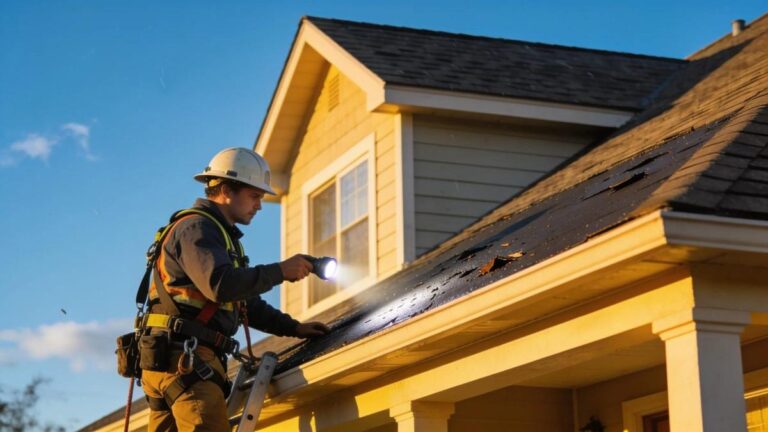
Structural distress is an engineering question. Once the snow is gone and the structure is cleared, a roofer’s inspection answers a different one: did the storm leave damage? We look at the surface, the flashing, the gutters and the eaves, and at the attic for stains, wet insulation and daylight where it should not be. Our roof inspections and maintenance page explains what that visit covers, and a written estimate separates anything that needs repair.
Ice deserves a second look. FEMA notes that temperatures swinging above and below freezing melt and refreeze snow into ice dams, which puts higher concentrated loads at eaves, and that is also where backed-up water gets under shingles. The ARMA manual describes the same cycle and recommends self-adhering eave flashing in cold climates. For how snow and ice behave along the gutter line, see our post on gutter guards in winter.
Frequently asked questions
Can a roof collapse from snow in New Jersey?
It is uncommon but possible. FEMA says most buildings are not at risk, yet snow in excess of design conditions can cause structural failure. Wet snow, rain on snow, ice and drifting raise the risk. Sagging ceilings, creaking, cracks and doors that stick are the warning signs to take seriously.
Is 12 inches of snow too much for a roof?
Not by depth alone. Twelve inches of light, dry snow weighs about 3 pounds per square foot, and a foot of wet, heavy snow about 21, per FEMA. Your roof’s design load, the age of the house, drifting and recent rain all matter. Watch for distress signs rather than relying on a depth.
Should I shovel snow off my roof?
FEMA says removing snow from a roof is more hazardous than beneficial more often than not. Falls, damaged roofing and injuries are the risks. If you are worried about the structure, leave and call a building official or engineer. Professionals with the right safety gear are the better route.
Does a roof need to be rated for 35 pounds per square foot of snow?
Morris County’s fallback ground snow load is 35 pounds per square foot under DCA Bulletin 19-1, but the real design value comes from the hazard tool for the exact address. The roof design load is calculated from that ground value, so ask your building department or an engineer for the number that applies to your home.
Who should I call about snow on my roof?
Call your town’s construction or building office or a structural engineer if you see warning signs. Call a roofer after the storm to check for leaks, damaged shingles, flashing and gutters. You can reach Hidalgo Brothers Roofing at (973) 525-6835 to schedule a written estimate for roof repair.
Sources and further reading
- FEMA: Snow Load Safety Guide, FEMA P-957, January 2013 (accessed 2026-10)
- NJ Department of Community Affairs: Bulletin 19-1, Design Loads for Ground Snow, Wind and Seismic (accessed 2026-10)
- Morris County: 2020 Hazard Mitigation Plan Update, Section 4.3.12 Severe Winter Weather (accessed 2026-10)
- ARMA: Residential Asphalt Roofing Manual, Design and Application Methods, 2014 (accessed 2026-10)