Can Your Siding Handle NJ Storms? Durable Materials That Last
What makes siding hold up in a New Jersey storm?
Storm performance depends on four things together: the material, how it is fastened, the water-resistive barrier and flashing behind it, and how well the house sheds water at the base and the roofline. A premium panel installed with poor flashing will leak, while a modest panel installed carefully can ride out many nor’easters.
Most storm damage to siding starts at edges and openings. Wind gets under a loose bottom edge or a cracked corner, rain follows it behind the cladding, and the damage shows up months later as soft sheathing or stained interior walls. Those weak points are worth checking after every major storm.
What kind of weather does New Jersey siding actually face?
NOAA’s state climate summary gives the baseline. New Jersey averages about 45.6 inches of precipitation a year, the north-central part of the state averages near 50 inches, and northern and higher-elevation areas get close to 30 inches of snow annually, compared with under 20 inches along the coast. Days with 2 inches or more of rain average about 2.2 a year, and the frequency and intensity of extreme rainfall are projected to rise.
The same summary describes nor’easters as cold-season coastal storms that can bring heavy snow, sleet or freezing rain and strong winds. It cites the January 31 to February 2, 2021 storm, which dropped widespread snow of about 2 feet, and the 2016 blizzard with gusts of 72 mph at Bayville.
For a house in Morris County, the practical hazards are wind-driven rain, snow and ice loads at the roofline, repeated freezing and thawing, and falling limbs. Few homes see hurricane-level winds, so the main job is keeping water out of the wall over decades.
How do the common siding materials perform in storms?
| Material | Where it tends to do well | Storm-related weak points |
|---|---|---|
| Vinyl | Sheds rain, does not rot, easy to replace panel by panel | Can crack from impact in cold weather; loose or over-tight fastening lets it rattle or buckle |
| Fiber cement | Non-combustible, does not rot, stable in humidity | Heavy; caulk and paint failures let water into edges; cutting creates silica dust |
| Real cedar | Traditional look and easy to repair | Needs finish upkeep and a dry wall; soaks in splash zones |
| PVC and composite cedar-look | No rot, mimics shakes or clapboard | Product-specific fastening rules; follow the maker closely |
| Metal and stucco | Used on some homes | Not a product line we install; dents, cracking and drainage details differ |
Hidalgo Brothers installs vinyl, Hardie Plank fiber cement, NuCedar, Everlast composite and cedar shakes. If you are considering a material we do not install, ask whether we can quote it.
Fixr’s 2026 pricing helps frame the choice: vinyl at roughly $3 to $12 per square foot installed and fiber cement at $5 to $14. Those are national averages from a third party, not a Hidalgo quote.
Does fiber cement really resist hail and fire better than vinyl?
According to its maker, yes in broad terms. James Hardie’s own article describes fiber cement as non-combustible and resistant to hail damage, and and says vinyl can melt and warp in the sun. Those are manufacturer statements and not independent testing, so ask for product data before relying on them.
Hail is uncommon but not unknown in New Jersey summers, and the more frequent threats are wind, rain and branches. A thick, rigid material tolerates impact better than a thin, flexible one, but rigidity does not help if the water-resistive barrier behind it is missing or torn.
Which installation details decide whether siding survives a storm?
Details beat brand names. These are the ones to ask about:
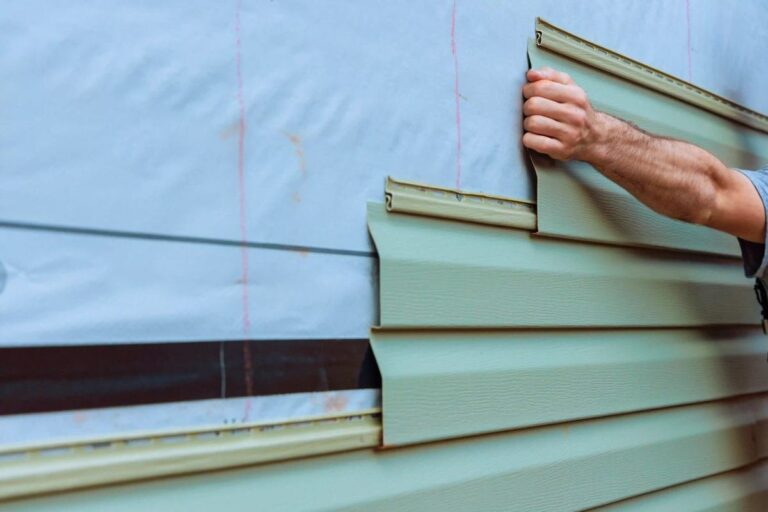
- Fastening. Vinyl must be nailed in the center of each slot with about 1/32 inch of play, according to the Vinyl Siding Institute’s installer tips, and the same source says fasteners should be no more than 16 inches apart on horizontal panels and 12 inches on vertical ones unless the maker specifies otherwise. For soffit in high-wind areas it advises nailing no more than 12 inches on center.
- Expansion room. Those tips note panels can move 1/2 inch or more over a 12-foot-6-inch run, with extra clearance at openings and stops when installing below 40 degrees F. Siding nailed tight cracks in cold snaps.
- Water-resistive barrier and flashing. Lapped barrier, flashing above windows and doors, and kick-out flashing where a roof edge meets a wall keep wind-driven rain off the sheathing.
- Ground and roof clearance. The bottom course should stay clear of soil, mulch, snow piles and the roof surface, as the product maker specifies.
- Corners and trim. Sealed, well-fastened corner posts and trim resist wind lift.
Cutting fiber cement adds a safety item. NIOSH warns that the dust contains crystalline silica and recommends dust-collecting saws connected to a vacuum and diamond-tipped blades for fiber-cement siding. That is a question to ask any crew you hire.
How do you inspect siding after a storm?
Walk the house in daylight once the wind has passed, from the ground, and look at each wall.
- Panels that are cracked, missing, bowed outward or hanging at the bottom edge.
- Dents, gouges or holes from impact.
- Caulk gaps at windows, doors, vents and trim.
- Water stains on soffits, interior walls under windows, or damp insulation visible in the attic.
- Debris, limbs or loose gutters resting against the wall.
Photograph everything with the date. If you suspect damage, contact your own carrier about how to document and report it; that is general homeowner guidance and not a service we provide. For roofs, see how we approach storm damage roof repair, and for seasonal prep read our fall checklist for gutters, roofing and siding.
Do siding repairs after a storm need a permit?
For existing one- and two-family houses, repair or replacement of siding is listed as ordinary maintenance in N.J.A.C. 5:23-2.7, with polypropylene siding excluded, and ordinary maintenance does not include work affecting structural or fire safety. If a storm also damaged sheathing, framing or the roof edge, call your town’s construction office before you start.
New Jersey’s Division of Consumer Affairs also advises homeowners to verify contractor registration before signing or paying a deposit, to get a written contract for jobs of $500 or more, and to avoid paying in full up front. Out-of-area crews who knock on doors after weather events are worth a second look on those points.
How do you choose between repairing and re-siding?
A few damaged panels on a sound wall are a repair. Repeated failures, soft or wet sheathing, widespread cracking, or panels that no longer lock together point toward replacement.
If you are comparing materials, our guide to vinyl, wood and fiber cement siding lays out cost and upkeep, and our siding team covers Morris County and neighboring counties. When you are ready for a written scope, use the free estimate form.
Frequently asked questions
Can high winds rip vinyl siding off a house?
Loose, poorly nailed or aged vinyl can peel in strong winds, especially at corners, the bottom lock and the gable ends. Properly fastened panels with intact locks resist better. If panels flap or whistle in wind, have the fastening and locks checked before the next storm.
Is fiber cement siding stronger than vinyl in a storm?
Fiber cement is heavier and more rigid, so it resists impact and wind lift better, according to its manufacturer. It still needs correct fastening, flashing and sealed edges. A rigid panel behind a poor water barrier can fail the wall just as easily as a flexible one.
Does heavy rain get behind siding?
All siding sheds water but is not fully watertight. Wind-driven rain gets behind laps, which is why the barrier and flashing behind the siding matter. Water stains below windows, bubbling paint on trim or musty odors suggest water is getting behind the cladding.
How can I tell if storm damage went through to the wall?
Look for soft spots when you press gently on sheathing exposed at damaged areas, dark staining, mold on interior wall corners, and moisture readings from a meter. If the siding is cracked open, a contractor can lift adjacent panels to check the barrier and sheathing before deciding on scope.
Should I trim trees near my house to protect siding?
Yes, branches that rub the wall or can fall on it are a common cause of scrapes, cracks and gutter damage. Have large limbs near the roofline removed by a tree professional, since that work carries its own risk.
Will new siding make my house safer in a nor’easter?
New siding in good condition with a proper barrier and flashing reduces water intrusion risk, but it does not make a house storm-proof. Roof condition, gutters, window seals and drainage all contribute, so treat the whole exterior as one system.
Sources and further reading
- NOAA NCEI / NCICS: New Jersey State Climate Summary (accessed 2026-11)
- Fixr: Vinyl siding cost (accessed 2026-11)
- Fixr: Fiber cement siding cost (accessed 2026-11)
- James Hardie: Does siding add home value? (accessed 2026-11)
- Polymeric Exterior Products Association (VSI): Vinyl siding installation tips (accessed 2026-11)
- CDC NIOSH: Controlling dust when cutting fiber-cement siding (accessed 2026-11)
- Cornell LII: N.J.A.C. 5:23-2.7, Ordinary maintenance (accessed 2026-11)
- NJ Office of the Attorney General: Hiring a home improvement contractor (accessed 2026-11)